
45% of New Company Wikipedia Articles Don't Last a Year: A Study of 409,433 Pages
409,433 is the number of all new English Wikipedia articles we followed (November 2024 – July 2026). Company articles are a subset of them; the company shares are estimated from a stratified sample with 95% confidence intervals.
Summary: what the study found
We analysed 409,433 new English Wikipedia articles from 2024–2026 to find out how often they are deleted and how long they stay published.
Key results
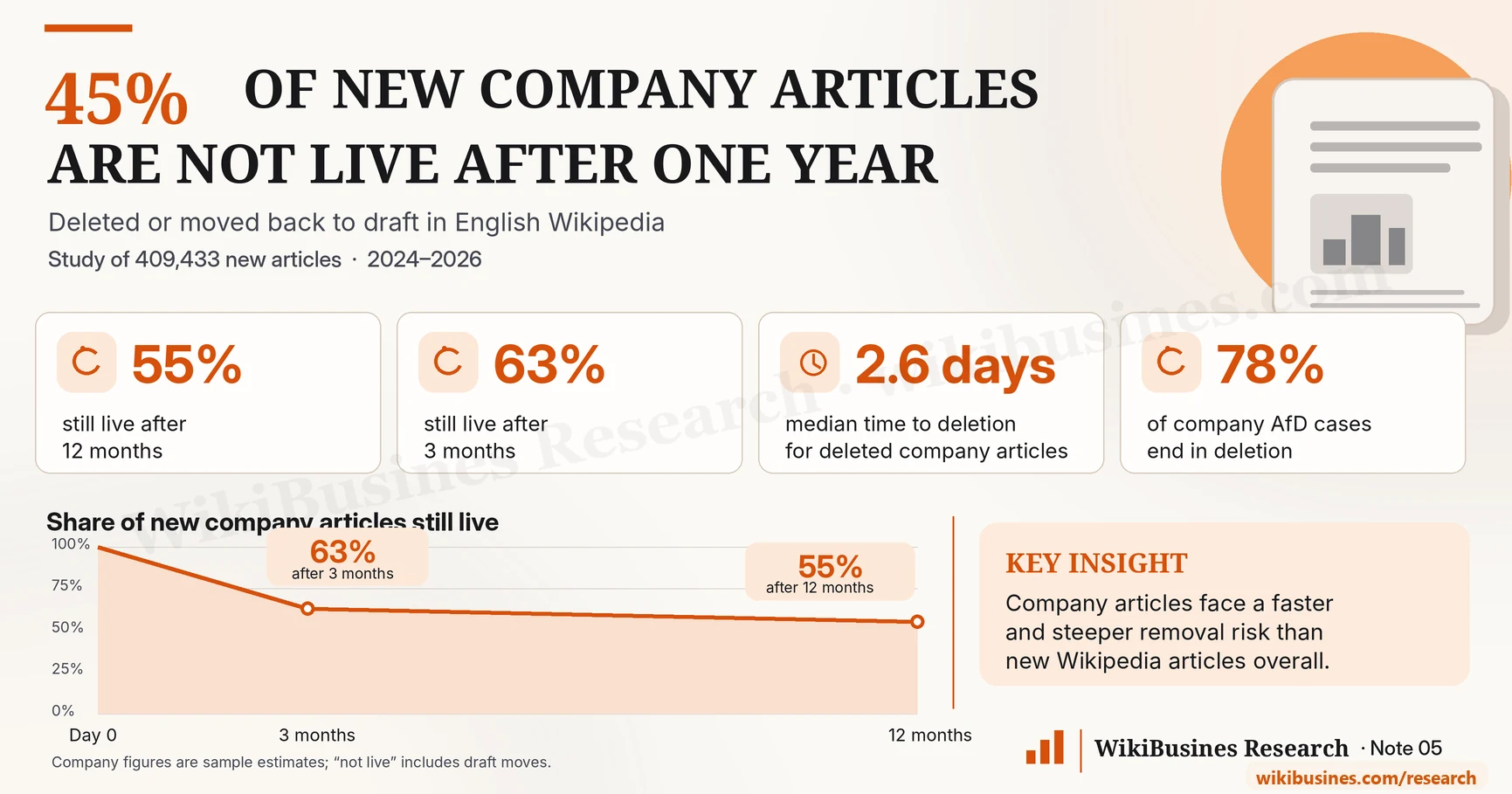
- 45% of new company articles are deleted or moved back to drafts within a year. Only 55% stay published.
- 63% of company articles survive the first three months. For all new Wikipedia articles the figure is almost 87%.
- 2.6 days is the median time to deletion for company articles that get deleted. For all new articles it is about 11 days.
- 78% of company articles that go to a deletion discussion (AfD) are eventually deleted. Only 11% are kept; another 7% become a redirect or are merged into another article.
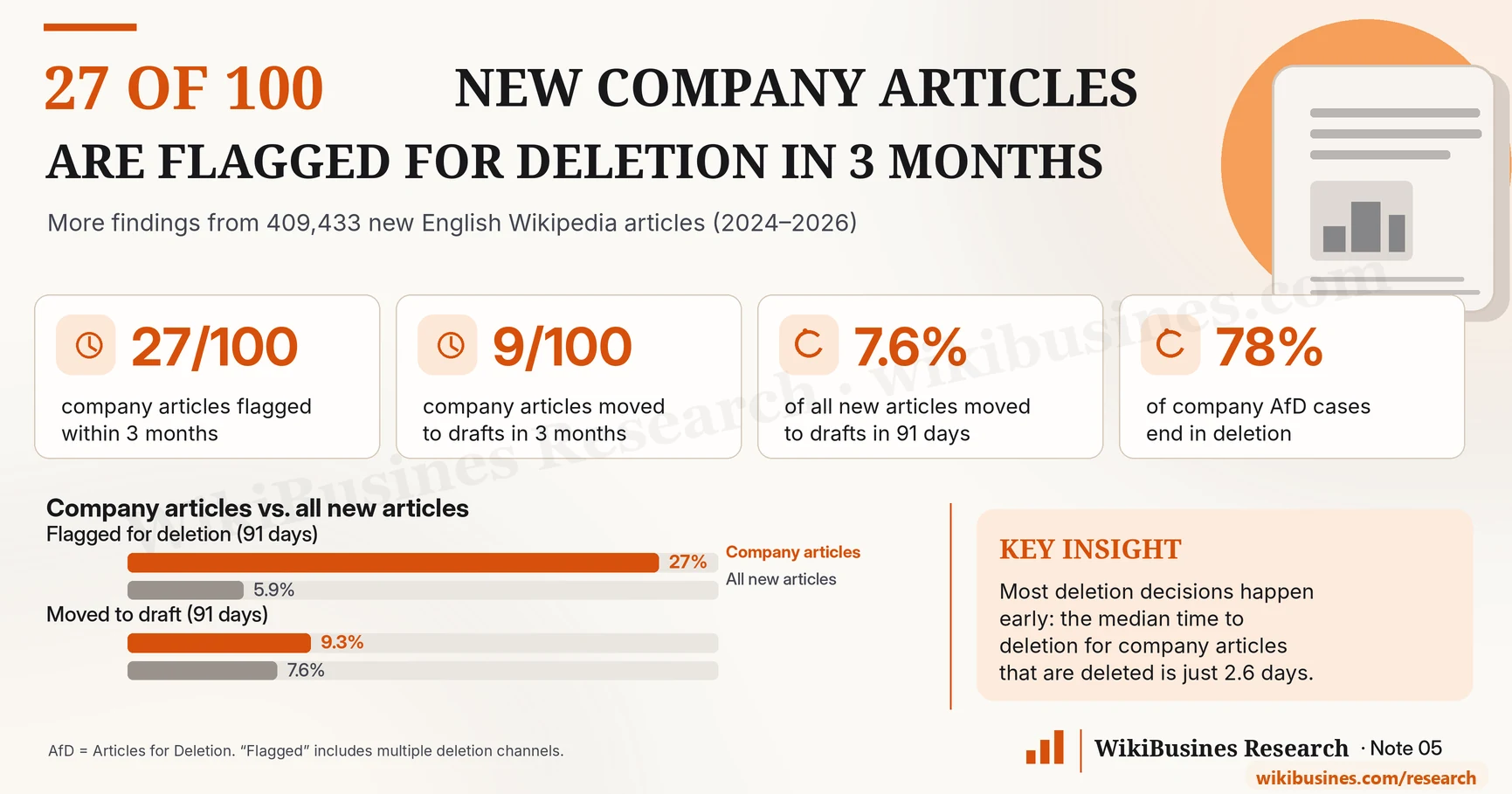
- 27 in 100 new company articles are nominated for deletion within the first three months.
- ≈15% of company articles are moved back to drafts within a year, which means they stop being publicly available encyclopedia articles.
The study also shows that a successful publication is not yet a long-term result. For a business, it is critical to have enough independent, authoritative sources before the article is created, rather than trying to fix things after publication.
The company shares are estimates from a stratified sample, not exact values for every company: the 95% confidence interval for 55% runs from 45 to 65%. Of the 45% that left, about 29% were deleted and 15% moved to drafts.
Key findings
- 1
Companies: of 100 new articles, 63 are alive after 3 months and 55 after 12 months sample estimate.
95% CI: 56–71 and 45–65. Deleted: 27 and 29; moved to drafts: 9 and 15 (the rounded figures add up to 99, not 100). For all new articles, 86.8% and 84.9% are alive; the gap to companies at 3 months is 23.5 pp, and the CIs do not overlap.
- 2
A company's fate is decided within days sample estimate.
Within 3 months, 27 of 100 new company articles were put up for deletion (CI 23–32): speedy deletion ≈17.5, AfD ≈7.5, LLMPROD ≈0.7, PROD ≈0.3 (the paths can overlap). The median time to deletion for a company is ≈2.6 days (101 deletions in the sample), for all new articles ≈11 days.
- 3
Businesspeople: a range, not a point sample estimate.
At 3 months, between 48 and 72 of 100 are alive; at 12 months, between 42 and 74. A deleted page about a businessperson is hard to tell from another biography: manual classification caught only 2 of 8 checked cases (recall 25%). The lower bound is calibrated to that recall; the upper bound counts only the deleted pages we could recognise. The range includes the company figure, so the data do not let us say that businesspeople survive better; the share of drafts is the highest, 19–30 of 100.
- 4
All new articles: 86.8% and 84.9% alive sample estimate.
By the logs (a full count), 6.6% of new articles are deleted within 91 days and another 7.6% are moved to drafts; 5.9% are put up for deletion. This sits next to the only public benchmark we found: 5.9% of new English Wikipedia articles not created with the Content Translation tool were deleted in January–March 2023 (Wikimedia Foundation). The methods are independent and not identical; the agreement in order of magnitude is a sanity check, not proof.
- 5
If an article reaches AfD, a company is deleted in 78% of cases known.
For companies (408 pages): deleted 78%, kept 11%, redirect or merge 7%. For businesspeople (271): 80 / 12 / 7. For all new articles taken to AfD (3,913): deleted 56.5%, kept 22%, redirect or merge 17%. The segment is set by the human topic-sorting label; this is a lower bound.
- 6
The quiet channel: drafts known.
Within 91 days, 7.6% of new articles are moved to drafts (draftify), three times as often as they are taken to AfD (2.2%). Among companies it is 9 of 100, among businesspeople 19–30. A draft is neither a deletion nor survival, and we did not track its final fate.
- 7
Dynamics: the share deleted within 91 days rose, but not because of companies known.
All new articles: 6.6% (cohort 2024Q4) → 5.5% (2025Q4) → 8.0% (2026Q2) → 8.4% (July 2026). The rise comes from LLMPROD (0.9% of the 2026Q2 cohort, 1.95% in July) and G5 (up to 2.9%). For companies no separate deterioration is visible: alive after 3 months 61% (2024Q4) and 66% (2026Q2), and the quarterly CIs overlap sample estimate.
Of 100 new articles: what is left after 3 and 12 months
Picture 100 new articles of one type in the main namespace of English Wikipedia. Below is what happens to them within 3 months (91 days) and 12 months. "Alive" means neither deleted nor moved to a draft. "Put up for deletion" means someone started a procedure: speedy deletion by content, PROD, an AfD discussion or LLMPROD. This is not the same as "deleted": for companies the two numbers are close (27 and 27), but they are different sets. Some of those put up for deletion survive, and some of the deleted pages went without a nomination, for example under G5 (pages by blocked authors, 1.7% of companies).
Of 100 new articles about companies after 3 months: 63 are alive, 27 were put up for deletion, 27 were deleted and 9 went to drafts. After 12 months: 55 alive, 29 deleted, 15 in drafts. For comparison, of 100 new articles of all kinds after 3 months, 87 are alive, 6 were put up for deletion, 6 were deleted and 7 went to drafts. "Put up for deletion" is a lower bound: some PROD and speedy nominations withdrawn before deletion are visible only in an audit of a sub-sample's history.
How articles disappear: speedy deletion, PROD, AfD and drafts
- Speedy deletion (CSD). An administrator deletes a page without discussion if it meets a narrow criterion: A7 — no indication of significance, G11 — promotional text, G12 — copyright violation. For companies, ≈17.5 of 100 new articles were put up this way within 3 months, against ≈2.0 among all new articles.
- PROD (proposed deletion). Any editor adds a tag; if nobody objects within 7 days, an administrator deletes the page. There is no public discussion.
- AfD (articles for deletion). A public discussion, usually about 7 days; an experienced editor closes it on the arguments, not on a headcount. Outcomes: deleted, kept, no consensus, redirect or merge.
- Draftify (move to draft). An editor moves the page from the main namespace to Draft and leaves a comment about what needs work. The article is not deleted, but it is no longer in the main namespace. A draft with no edits for 6 months can be deleted under criterion G13; this study does not track the final fate of drafts.
- LLMPROD and G5. LLMPROD is a proposed deletion of text that looks LLM-generated (it appeared in the log in 2026). G5 is a mass deletion of pages created by accounts that were later blocked. Both paths affect every topic, not only companies.
Speedy deletions and PROD together account for more of the attrition than AfD: only 2.2% of new articles ever get a public discussion.
What was already known about new-article survival
We found no published analogue that breaks down new-article survival by topic (companies, businesspeople, other people) and by 3- and 12-month horizons. The search was shallow (a few dozen queries and pages), we did not do a full literature review, and closed Wikimedia Foundation studies are entirely possible. The closest benchmark concerns all new articles: in the Content Translation statistics, the share of deleted articles created without that tool in January–March 2023 was 5.9% for English Wikipedia. Our 5.8% (sample) and 6.6% (logs) within 91 days sit next to it, although the measurement windows differ.
The rest of what we found is tangential: a report on the experiment that limited article creation to autoconfirmed accounts (2017–2018) and a 2013 study of deletion on Wikipedia using data up to 2011. They have no breakdown by topic or horizon.
How hundreds of articles drop out
Each dot is one new article. The final shares are real data; the path between checkpoints in the first scene is schematic. Phases play on their own, a click on a phase stops them, "Replay" starts again.
100 new company articles: the first 3 months
Companies on the left, 100 of all new articles on the right for contrast. Live ones stay in the grid; deleted and draftified ones drop out below.
A year of life: from 3 to 12 months
The same hundred companies at three checkpoints; a ring marks those that left after month 3. The last phase compares with all new articles.
The quiet channel: drafts versus AfD
1,000 new articles, 91 days: where they leave the main namespace. The dots are rounded; exact shares are in the labels.
Survival by segment, 3 and 12 months
Bar length is the share of 100 new articles in the segment: alive, in draft, deleted. The right-hand "Alive" column is highlighted with the 95% CI; the whiskers on the bars are the same CI. Businesspeople are a range (hatched zone).
Estimates from a stratified sample (21,000 live and 1,124 deleted or draftified rows), 95% CI by bootstrap. "Other people" is the uncalibrated variant. 3 and 12 months are different sets of cohorts. Data: segments_summary.csv, CC BY 4.0.
Dynamics by entry quarter
The top panel is the share of new articles deleted within 91 days (full logs), split into LLMPROD and G5, and the share moved to drafts. The bottom one is the share alive after 3 months with a 95% CI: companies and all new. 2026Q3 is July only.
The bottom axis does not start at zero, so differences look larger than they are. A cohort is the quarter of entry into the main namespace. Data: dynamics_exact_all_logs.csv and dynamics_quarterly.csv.
78% of company articles sent to AfD are deleted: what our Wikipedia analysis shows
On the left, the paths through which 100 new articles are put up for deletion within 3 months (companies versus all new). On the right, what happens to a page that reached AfD; the "Kept" column is highlighted.
The paths can overlap, so they do not add up to "put up for deletion". AfD result: "Kept" = keep or no consensus; "Redirect" = redirect or merge; "Draft and other" apart. The AfD segment is a human topic-sorting label, a lower bound. Data: segments_summary.csv, afd_new_articles.csv.
Data
Table: survival of new articles by segment and horizon (estimate from a stratified sample, 95% CI). For businesspeople it is a range: the first end is calibrated to the recall of recognising deleted businesspeople, the second counts only those recognised. "Put up for deletion" is a lower bound (AfD, PROD, LLMPROD, speedy deletion by content; without G5 and technical ones). "Other people" is shown uncalibrated, because calibration takes the missing businesspeople from exactly that segment. At the bottom of the page are aggregated CSV files: they contain no page titles.
| Segment | Horizon | Alive, % (95% CI) | Deleted, % | To draft, % | Put up for deletion, % (95% CI) | Sample: live / deleted |
|---|---|---|---|---|---|---|
| All new articles | 3 mo | 86.8 (86.4–87.3) | 5.8 | 7.5 | 5.9 (5.7–6.1) | 19089 / 930 |
| Companies | 3 mo | 63.3 (56.2–71.4) | 27.4 | 9.3 | 27.4 (22.7–32.0) | 355 / 104 |
| Businesspeople (range) | 3 mo | 48–72 (33–87) | 9–22 | 19–30 | 12–17 | 248 / 380 |
| Other people | 3 mo | 84.6 (82.3–86.6) | 7.0 | 8.4 | 6.6 (5.9–7.2) | 5765 / 348 |
| Other organisations | 3 mo | 83.4 (78.0–89.3) | 8.2 | 8.4 | 10.4 (8.8–12.2) | 1050 / 79 |
| Other topics | 3 mo | 89.2 (87.9–90.5) | 4.0 | 6.8 | 3.7 (3.4–4.0) | 11005 / 367 |
| All new articles | 12 mo | 84.9 (84.1–85.5) | 7.2 | 8.0 | 7.3 (7.0–7.6) | 10852 / 548 |
| Companies | 12 mo | 55.3 (44.8–65.5) | 29.3 | 15.5 | 30.8 (23.5–38.6) | 197 / 62 |
| Businesspeople (range) | 12 mo | 42–74 (23–92) | 10–25 | 17–33 | 15–21 | 146 / 211 |
| Other people | 12 mo | 82.1 (79.6–84.4) | 8.2 | 9.7 | 7.9 (6.9–8.9) | 3297 / 195 |
| Other organisations | 12 mo | 79.5 (71.5–87.6) | 9.2 | 11.3 | 11.9 (9.2–14.8) | 627 / 51 |
| Other topics | 12 mo | 88.0 (86.2–90.0) | 5.6 | 6.4 | 4.6 (4.1–5.2) | 6151 / 224 |
Interpretation
WikiBusines Research data show that a new article about a company on English Wikipedia has roughly two chances in three of surviving 3 months (63, CI 56–71) and slightly more than half of reaching a year (55, CI 45–65), and that this is decided mostly in the first days: the median time to deletion is ≈2.6 days. Main hypothesis hypothesis: companies drop out faster than other topics not because Wikipedia is harsher in general, but because the first filter is the speedy criteria (A7, G11), applied within days and without discussion; an article without independent sources does not even live to reach AfD. Most likely scenario for the next 6–12 months hypothesis: the 3-month figure for companies stays within the same limits (quarterly estimates 2024Q4–2026Q2: 54–72%), while the overall share deleted within 91 days among all new articles will depend on the LLMPROD wave: by the model below, from 6.1 to 10.4% for the July 2027 cohort.
Has Wikipedia become harsher? The share deleted within 91 days among all new articles rose from 5.5% (2025Q4) to 8.4% (July 2026). Without LLMPROD and G5 it is ≈5.1% in 2024Q4 and ≈4.8% in 2026Q2, so it does not rise. This is mass clean-up mixed with the quality of new articles; our data cannot separate them, because the clean-ups also act on older cohorts.
Why do companies drop out quickly? This is a hypothesis; the data do not prove it. By the data, speedy deletions account for ≈17.5 of 100 new company articles against ≈2.0 among all, and the median time to deletion is ≈2.6 days: criteria A7 (no indication of significance) and G11 (promotion) are applied without discussion. Whether this is really a filter on articles without sources, we did not check: the sample is not coded for the presence of independent sources.
Why are businesspeople a range? A deleted page has no categories, and it is hard to tell a businessperson from another person by the title: manual coding caught 2 of 8 checked businesspeople. So the lower bound is calibrated and the upper bound counts only those recognised. The data do not prove that businesspeople survive better than companies; they show only a high share of drafts.
What do these data not show? They do not show the quality of specific articles and their sources, the final fate of drafts, survival by entry route (straight into the main namespace or through Articles for creation; about 14% of entries are moves from Draft), or the reason for deletion in each case. These are estimates for the whole population of new articles, not the probability that a page with specific sources is deleted.
Summary, hypotheses and forecast
What we know
- Of 100 new articles about companies, 63 are alive after 3 months (CI 56–71) and 55 after 12 months (45–65); for all new articles 86.8% and 84.9%. sample estimate
- Median time to deletion for a company ≈2.6 days; speedy deletion ≈17.5 of 100 new company articles against ≈2.0 for all. sample estimate
- If a company article reaches AfD, 78% are deleted and 11% kept (408 pages). known
- 7.6% of new articles go to drafts within 91 days against 2.2% that reach AfD. known
- Share deleted within 91 days: 6.6% → 5.5% → 8.0% → 8.4%; without LLMPROD and G5 ≈5.1% → ≈4.8%. known
Hypotheses and what would test them
- H1. The 2026 rise in deletions is mass clean-up (LLMPROD, G5), not worse new articles. hypothesis Would confirm: in the next update (cohorts 08.2026–01.2027) the LLMPROD share of cohorts falls below 1%, and the share deleted within 91 days without LLMPROD and G5 stays within the historical range (3.6–5.2%). Would refute: without those two layers the share deleted rises above 5.2%.
- H2. Companies drop out fast because the speedy criteria (A7, G11) act within days and without discussion. hypothesis Would confirm: in new cohorts speedy deletion stays at 15 or more of 100 new company articles and the median time to deletion stays under 5 days. Would refute: the share of speedy deletions falls while company survival does not rise (attrition shifts to AfD).
- H3. Drafts are the main "quiet" substitute for deletion, and most of them do not return. hypothesis Would confirm: tracking drafts for 6 months or more shows that fewer than a quarter return to the main namespace and the rest are deleted under G13 or stay. Would refute: most return.
How we read it
In plain terms. A new company page on English Wikipedia is like a start-up: 37 of 100 do not make it through the first 3 months, and most of that attrition happens in the first days, before any public discussion. Those that reach a year lose a few more through drafts. Public AfD, which people usually count on, covers a minority of cases, and drafts (the quiet channel) three times more.
What to do about it. The decisive moment is publication, not nomination. Independent sources must exist before the page enters the main namespace, and the first weeks call for daily monitoring. The company figure neither rises nor falls across the quarters, so there is no reason to expect that it "will get easier".
Forecast and modelling
The model is simple: the share of new articles deleted within 91 days = a base level without LLMPROD (6.0%, the mean of the last 12 monthly cohorts) + an LLMPROD layer that starts from the mean of the last three cohorts (1.38%) and is multiplied by g each month, + a drift of the base level d (pp a month). The July cohort (8.4%) is above the averages because LLMPROD in it is 1.95%. Three scenarios for 12 months (cohorts 08.2026–07.2027): baseline (g = 1.00, the layer stays at the level of the last three months), milder (g = 0.75, the wave fades), harsher (g = 1.10, the wave grows). The sliders let you set your own assumption.
The model illustrates assumptions; it is not a prediction.
What to do
For companies: the first 3 months are the riskiest
Of 100 new company articles, 37 drop out within 3 months and about 8 more over the next 9; the median time to deletion is ≈2.6 days, so the fate is decided within days. Practical steps that follow from Wikipedia policies and these data:
- Before publishing, check that independent sources exist: publications, books, academic works that give the company a substantive part of the text and that were not created by it or by its agency. Material placed through press-release wires (services that distribute press releases: PR Newswire, Business Wire, GlobeNewswire) does not count as independent.
- Submit the page through Articles for creation (a draft and a review) or give it to an experienced editor with an edit history. We did not measure survival by entry route; this is a recommendation from policy, not a conclusion from the data.
- Disclose the connection to the company and any payment: under the Wikimedia terms of use this is mandatory.
- Watch the page daily in the first week and weekly up to 3 months: the edit history, tags on the page, the talk page.
- If the article is moved to a draft, find the reason in the comment, add independent sources and resubmit; if it is put up for deletion, answer on the substance of the policy, without canvassing and without extra accounts.
For agencies: do not publish to the main namespace without independent sources
"Publish and see" yields the base rate: 37 of 100 drop out within 3 months and 27 are put up for deletion. Bulk publishing from a template risks falling under LLMPROD and G5 regardless of notability. These data are for assessing the risk before publication and deciding whether independent sources exist for the topic, not for getting around the rules: the community of editors decides, and nobody can guarantee that a page will stay.
Six questions before publishing.
Methodology and limitations
Window: cohorts entering the main namespace of English Wikipedia from November 2024 to July 2026 (21 months, 409,433 non-technical new articles, about 19.5 thousand a month); for 12 months, cohorts 11.2024–10.2025 (232,457 articles). Data collected on 12–13 November 2026. A "new article" is a page created in the main namespace (not a redirect) or moved there from Draft or a user page. "Alive" at 3 months (91 days) and 12 months (365 days) means neither deleted nor moved to a draft. Technical entries (redirects, page swaps, renames) are excluded.
Design: the denominator and all deletions come from the full creation, move and deletion logs (exact, no sampling), and the topic comes from a stratified sample: 21,000 live pages (1,000 a month) and 1,124 deleted or draftified ones. Live pages were classified automatically (Wikidata P31 and P106 and visible categories); deleted and draftified ones manually by title and comment, calibrated against AfD labels. The share estimate is a sum of weights; the 95% CI is a stratified bootstrap (300 replicates).
"Put up for deletion" (narrow): AfD, PROD and BLPPROD, LLMPROD, speedy deletion by content (A7, G11, G12, G3, A1, A3, G10, G15); without G5, G6, G7, G8, G13 and technical ones. This is a lower bound: PROD and speedy nominations that were contested or withdrawn are visible only from an audit of a sub-sample's history (≈2–3% of live pages).
Businesspeople: the weakest link. A deleted page has no categories; manual classification caught 2 of 8 businesspeople in a check against AfD labels (recall 25%, CI 14–69%). So a range is given: calibrated and uncalibrated variants; the CIs are merged.
Accuracy: manual classification of deleted pages against AfD labels (n = 78) is 77% overall; for companies recall 70% (7 of 10), precision 58% (AfD labels under-flag companies, so this is a lower estimate); for businesspeople recall 25%. The live classifier was checked by hand on 50 pages: 46–48 correct; a recall probe showed that some companies (newspapers, TV, bookshops) fall into "other organisations", so live companies may be understated by 10–15%. One rater did the classification and was not blind to the deletion comments; there was no second rater.
AfD: matching by title at entry against cohorts 11.2025–07.2026, 3,913 distinct pages out of 176,976; the outcome is the last closed AfD within 91 days of entry; a lower bound (renamed pages are missed). The AfD segment is a human topic-sorting label.
Limitations: (1) redirects and converted articles (≈2%) have no segment and appear only in "all new"; (2) for 12 months "put up for deletion" is understated more; (3) retroactive clean-ups (G5 and LLMPROD; of the 01–10.2025 cohorts, 2.0% and 1.4% were already deleted by 11.2026) mix the quality of new articles with late clean-up; (4) quarterly CIs for companies are wide (33–62 live and 4–16 deleted sample rows per quarter), and cohort 2026Q3 is July only; (5) a move from Draft enters the cohort on the move date, not by the age of the draft; (6) the final fate of drafts is not tracked; (7) 3 and 12 months are different sets of cohorts, so compare them with care; (8) rare cases (oversight, deletion followed by restoration) can distort individual pages. There are no page or user names in the publication; nothing was edited on Wikipedia.
Sources
English Wikipedia policies and pages and Wikidata that the note relies on; the data sources are the creation, move and deletion logs, AfD discussions and Wikidata.
- Content translation: Deletion statistics comparison (Wikimedia Foundation)www.mediawiki.org/wiki/Content_translation/Deletion_statistics_comparison
- Criteria for speedy deletionen.wikipedia.org/wiki/Wikipedia:Criteria_for_speedy_deletion
- Proposed deletion (PROD)en.wikipedia.org/wiki/Wikipedia:Proposed_deletion
- Articles for deletion (AfD)en.wikipedia.org/wiki/Wikipedia:Articles_for_deletion
- Drafts and draftificationen.wikipedia.org/wiki/Wikipedia:Drafts
- Articles for creationen.wikipedia.org/wiki/Wikipedia:Articles_for_creation
- Notability of organisations and companies (NCORP)en.wikipedia.org/wiki/Wikipedia:Notability_(organizations_and_companies)
- Paid-contribution disclosureen.wikipedia.org/wiki/Wikipedia:Paid-contribution_disclosure
- MediaWiki logs (API Logevents)www.mediawiki.org/wiki/API:Logevents
- Wikidatawww.wikidata.org/
Licence
Data and charts are released under CC BY 4.0 with attribution to "WikiBusines Research". The text of the study is © WikiBusines, CC BY-NC 4.0.
Downloads are aggregates by segment, quarter and month only: no page titles, no deletion comments, no user names. Charts may be reused with attribution: "WikiBusines Research".
WHAT TO DO ABOUT IT
Check your company before you publish, not after the deletion
An article's fate is settled before it goes live: either the independent sources exist or they don't. We assess your company's notability against Wikipedia's rules and tell you honestly whether an article makes sense now.
- Quick assessment, about 10 minutes — free
- If in doubt, a notability audit from €490, credited toward the page
- We publish with paid-editing disclosure, as Wikipedia's terms require