Wikipedia notability audit: source check before you pay for a page
We test every one of your sources against the same criteria Wikipedia editors apply in a deletion discussion, and answer in writing: yes, not yet, or here is a shorter route. The audit fee is credited toward page creation if you order it within one month.
WikiBusines: the notability audit is paid, from €490, with the result in 5 days; when the case is clear-cut, the free 10-minute assessment is enough.
The audit fee is credited in full if you commission page creation from us within one month. All prices
01 Why audit
Cost of a notability audit: compared with a deleted page
Most deleted articles were doomed before the first edit: the sources fell short of the bar. Deletion costs more than the budget. The discussion stays in Wikipedia's public archive, and a similar article can later be deleted quickly, without a new discussion.
Without an auditwrite the page straight away
Week 0Page from €1,620The text is written from whatever sources were at hand.
Week 4PublicationThe article goes live in the main namespace.
≈ 3 weeks laterDeletion nominationAn editor finds no independent coverage.
7-day discussionDeletedThe budget is lost and the discussion stays in the archive.
With an auditcheck the sources first
Day 0Audit for €490You send the name and your strongest articles.
Day 5Written verdictEvery source is graded and the deletion risk is rated.
If “yes”Page, audit credited within a monthWe write from sources that withstand review.
If “not yet”A plan instead of a lossNo money spent on a page, and you have a route to one.
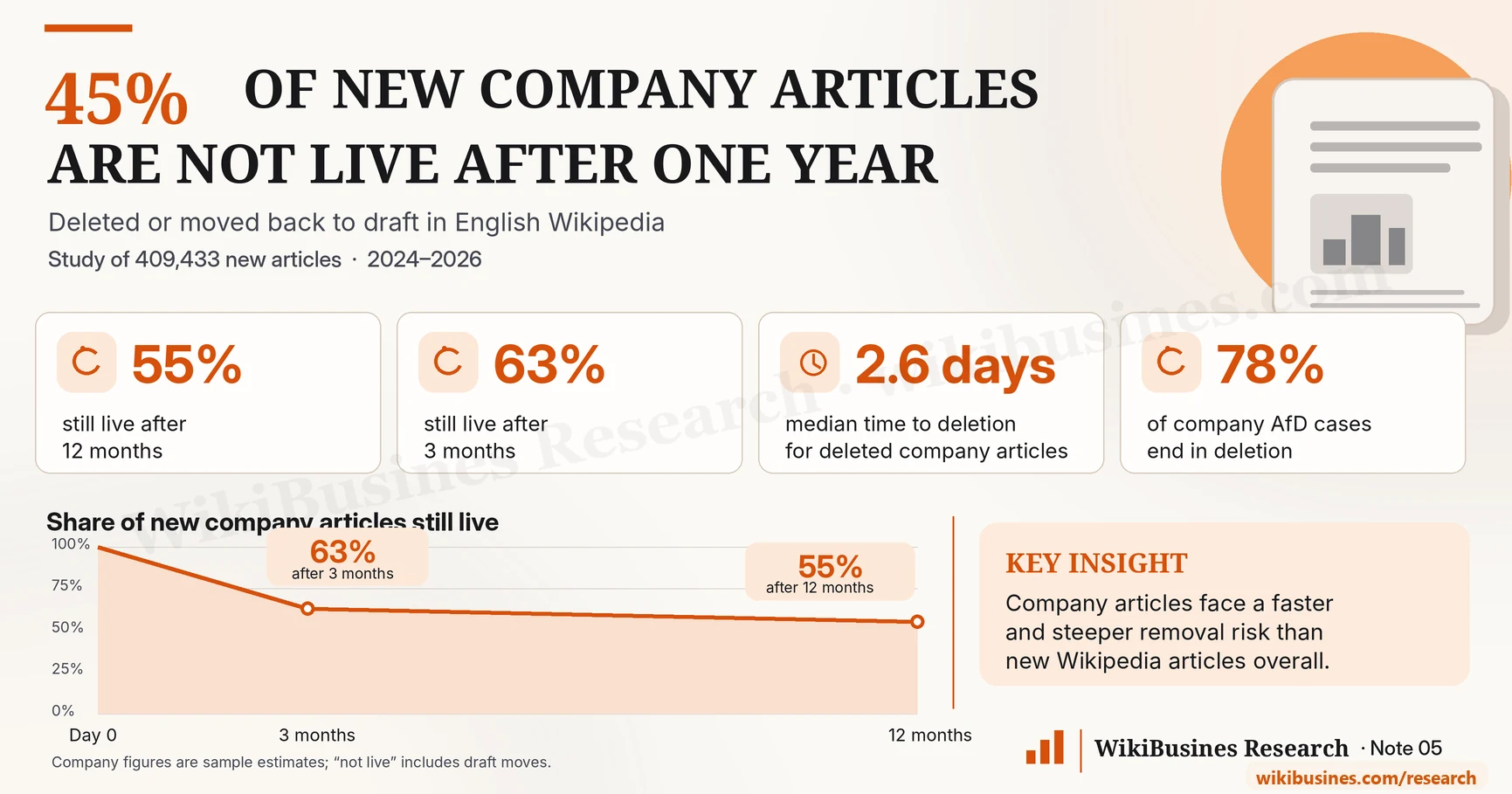
45%of new company articles on English Wikipedia are deleted or moved back to drafts within a year
2.6 daysmedian time to deletion for the company articles that get deleted
78%of company articles that go to a deletion discussion (AfD) are eventually deleted
Source: WikiBusines study of 409,433 new English Wikipedia articles, 2024–2026.
Wikipedia notability criteria: six tests for every source
Notability is not about how good your company is. It is about whether independent coverage already exists. A source counts only when it is independent, reliable and in-depth at the same time. One strong dimension does not carry the rest.
DepthThe source covers you directly and in depth. Passing mentions do not count.WP:SIGCOV
Independent authorNot you, your team, contractors or sponsors.WP:IS
Independent contentOriginal journalism, not a rewritten release or quotes from an interview.WP:ORGIND
ReliabilityAn editorial team with fact-checking. Editors have already ruled some outlets unreliable.WP:RSP
Secondary sourceNot your website, registries, patents or award lists.WP:PSTS
Wide reachAt least a regional or national audience. Local press alone is rarely enough for a company.WP:AUD
Source
An in-depth piece by a staff journalist about your company
A national outlet, about 1,200 words, with interviews of customers and competitors.
✓Depth: covers the company directly and in depth
✓Independent author: staff journalist with no tie to you
✓Independent content: original work: interviews, comparisons, context
✓Reliability: an editorial team with fact-checking
✓Secondary source: an independent account, not your document
✓Wide reach: a national audience
Counts. One source like this can anchor a page.
Source
A news item on a well-known site, almost word for word from your release
Three paragraphs, the “the company today announced” formula, one quote from the CEO.
~Depth: only the fact of the round, no analysis
✓Independent author: an editorial-desk byline
✕Independent content: content taken from the release
✓Reliability: the outlet is reliable
✓Secondary source: secondary in form
✓Wide reach: a national audience
Does not count. The content is not independent, and a well-known domain does not fix that.
Source
A column on forbes.com by a contributor
The open-contributor section, with no editorial review.
✓Depth: writes about you in depth
~Independent author: not a staff writer, often tied to the topic
~Independent content: often built from company talking points
✕Reliability: editors consider it generally unreliable
✓Secondary source: secondary in form
✓Wide reach: a wide audience
Does not count. An open-contributor platform without editorial oversight.
Source
An interview with the founder in question-and-answer form
The journalist asks the questions, then it is only the founder's answers.
✓Depth: about you
✓Independent author: the journalist is independent
✕Independent content: the answers are yours, not analysis
✓Reliability: the outlet is reliable
✕Secondary source: essentially primary: your own words
✓Wide reach: a good audience
Does not prove notability. Can confirm individual facts in an article.
Source
An in-depth piece in a city newspaper
A report by a staff writer about your company, 900 words.
✓Depth: in depth
✓Independent author: staff writer
✓Independent content: original journalism
✓Reliability: an editorial team with fact-checking
✓Secondary source: secondary
✕Wide reach: a local audience only
Partly. Adds depth, but for a company it cannot hold a page on its own.
What never counts
Press releases
BusinessWire, PR Newswire, GlobeNewswire or a company newsroom. This is self-publication.
Paid placements
Forbes BrandVoice, “Sponsored”, partner and advertorial content.
PR interviews
Question-and-answer format without independent journalism around it.
SEO blogs and aggregators
Listicles, directories and “best of” roundups with no editorial standard.
Rewritten releases
Even on a well-known domain, a retelling of a release is rejected.
Social media
YouTube, TikTok, Instagram and LinkedIn are not reliable sources.
A wire story reprinted everywhere counts as one source. And coverage has to be sustained, not a single spike.
Journalism or a rewritten press release: what counts as a source
A piece counts as a source when the journalist did independent work rather than rewriting what the company handed over. Compare two versions of the same news.
Technology section · Staff writer
How Solarity Systems became a key player in the European AI energy market
In four years, Solarity Systems has grown from a research project in Munich into one of Europe's fastest-growing grid optimization companies. According to analysts at Euler Consulting, the company processes data from more than 2.4 million smart meters.
In an interview with the outlet, co-founder Lukas Eberhardt explained what sets their model apart. Sofia Lindholm, a partner at Northwind, said the fund spent four months vetting the technology before investing.
At the same time, the company faces regulatory challenges: the EU is demanding more transparent AI models for critical infrastructure.
Solarity Systems today announced the close of its €42 million Series B round. The company is a leading provider of innovative energy solutions.
“We are delighted to welcome our new partners and will keep transforming the industry,” said the company's CEO.
More information at solarity.example.
A full example of an article that passes as a source
Over the past four years, Solarity Systems has evolved from a small Munich-based research project into one of Europe's fastest-growing AI-driven energy optimization companies. Founded by former Siemens engineer Lukas Eberhardt and data scientist Anna Gruber, the company focuses on predictive load-balancing and grid-efficiency tools used by utilities across Germany, the Netherlands and the Nordic region. According to analysts at Euler Consulting, Solarity now manages data streams from more than 2.4 million smart meters.
In an interview, Eberhardt explained that Solarity's competitive advantage comes from “hyper-local modeling”, which combines IoT sensor networks, satellite weather data and machine-learning forecasts in near real time. “Utilities need granular, dynamic systems, not monthly spreadsheets,” he said.
In 2024, Solarity closed a €42 million Series B round led by Sweden's Northwind Capital. The round valued the company at €310 million, according to documents reviewed by the publication. Northwind partner Sofia Lindholm said the fund carried out a four-month technical audit before investing.
Despite the momentum, Eberhardt stresses that Solarity faces complex regulatory and operational challenges, especially as the EU pushes for more transparent AI models in critical infrastructure. With more than 140 employees across four offices, the company is positioning itself as a foundational player in Europe's move toward more flexible energy networks.
The benchmark: one article of this depth plus 2–3 supporting pieces in reputable media, and a page usually survives a deletion discussion. Solarity Systems does not exist; the example is composed for illustration.
Paid-content labels in major outlets: ten labels that disqualify a piece
A famous domain does not save a piece if a label next to the headline or in the byline marks it as paid, member or contributor content, or if it is a reprinted press release. Reviewers see these labels first.
ForbesLeadership
COUNCIL POST | Membership (fee-based)
Five Lessons From Scaling A Startup Across Europe
Jane Doe, Forbes Councils Member
ForbesInnovation
BRANDVOICE | Paid Program
How One Company Is Rethinking The Future Of Work
Brand N, Brand Contributor
ForbesMarkets
Why This Fintech Could Change Payments In 2026
Jane Doe, Contributor
EntrepreneurLeadership
What I Learned From Building A Company Twice
Jane Doe, Entrepreneur Leadership Network® Contributor
Opinions expressed by Entrepreneur contributors are their own.
The New York TimesPaid Post
Paid Post · Brand N
A New Vision For Cities Of Tomorrow
The GuardianGuardian Labs
Paid content
Ten Places To Visit This Winter
Paid for by Brand N
BloombergMedia Studios
Sponsored Content
Thinking Capital: Where Growth Comes From Next
Brought to you by Brand N
HuffPostContributor
Why Every Founder Should Write A Daily Journal
Jane Doe, Contributor
This post was published on the now-closed HuffPost Contributor platform.
Yahoo FinanceGlobeNewswire
This is a paid press release.
Company N Announces Record Growth And New Partnerships
Company N
FortuneBrand Studio
PAID CONTENT
The New Rules For Running A Global Team
Does not count
Page sketches, not screenshots. Label texts were checked against live outlet pages in November 2026; headlines and names in the examples are made up.
Source reliability on Wikipedia: four tiers of outlets
This is how reviewers sort outlets in practice. It is not published policy but a consensus built over years of discussion on the reliable sources noticeboard.
Tier 1Reuters, BBC, Bloomberg, FT, WSJ, NYT
In a discussion, one such source weighs as much as three regional ones.
Tier 2DW, Forbes editorial, TechCrunch reporting, national newspapers
Citing these in a draft makes a reviewer distrust it.
1
333
One Tier 1 source on the scaleOne regional source, Tier 3A second regional sourceThree regional sources balance one Tier 1 source
A note on Forbes. Editors consider Forbes Contributor columns generally unreliable. Only staff-written Forbes editorial counts. The same goes for HuffPost Contributor and similar open-contributor platforms.
English Wikipedia
3–5 independent staff-written pieces
Ideally one long-form article, like the example above
No paid or contributor content
Other language editions
2–3 strong pieces are often enough
They must still be independent and non-promotional
891 outlets rated by Wikipedia editors: database of rated outlets
Our open media base shows how Wikipedia editors rate outlets, from generally reliable to ones to avoid. Look up your outlet, or sort your own mentions into tiers.
Notability of a founder or executive: separate from the company
A company's notability does not pass to its head automatically. Even for Borys Paton: the institute he led for 67 years bears the name of his father, Yevhen Paton.
Historical overview
History of the E. O. Paton Electric Welding Institute
About the institutionEncyclopedia
Biographical article on Borys Paton
Biography of a personTechnical journal
Review of the institute's welding technologies
About the institutionScientific journal
Analysis of Borys Paton's role in creating electroslag welding
Analysis of his contributionNews
Report on the activities of the National Academy of Sciences
About the institutionMedical journal
The method of welding soft tissues and its authors
His idea, collective work
3 of 6 pieces are about institutions
The institute's history, its technologies, the academy report. They establish the notability of institutions, not of the person who headed them.
3 of 6 pieces are about the person
A biographical article, an analysis of his personal contribution and a description of a method he originated. A biography stands on sources like these.
A piece about an institution also counts if it examines a specific person's role in depth and independently. The titles describe types of material, not specific publications.
Who meets the notability criteria: and who should wait
Wikipedia has separate criteria for companies and for each field of human activity. These benchmarks come from our experience, not from official rules. The audit turns a guess into a verdict on every source.
Wikipedia notability self-check: seven signals and four risks
Tick what is true for you. This is a guide, not a verdict: notability is decided by the community, not a checklist. But pages that fall short on several points at once rarely survive review.
Required
Desirable
A plus
Risks tick any that apply
12 Your situation
First step before a Wikipedia page: two questions to choose
A page may already exist, it may have been deleted, or there may be too little coverage so far. Each case has its own first step.
Question 1
Do you already have a Wikipedia page?
Question 2
What state is it in now?
Question 2
Have independent outlets written about you in depth?
Your first step
Protect the page
Annual support gives a 12-month guarantee, updates and editorial consultations.
What to do after a “not yet” verdict: a sequence of steps
The audit tells you which rung you are on and what it takes to climb. We do not sell page creation if the sources cannot support it.
Step 1A Wikidata entry
Structured data with a lower bar. It already feeds the Google knowledge panel and AI answers. Usually the first win, from €680.
Step 2Simple English or another language edition
Sometimes a more realistic start. The notability rules apply here too, and we will tell you if it will not hold.
Step 3Coverage first
Earn the independent pieces you are missing. The audit defines which ones and in what order.
Step 4English Wikipedia
Only once the sources clearly clear the bar. There is no point paying for a page that is deleted within a week.
Source Readiness Program
So the page becomes a question of “when”, not “whether”
Sequenced work over 3–6 months that builds the real coverage Wikipedia requires: independent, reliable and in-depth at once, not a pile of clippings. Built around the same six tests as the audit.
Price
€1,200–€2,000
3 levels by scope
Timeline
3–6 months
paced, not rushed
Credit
100%
toward page creation within 12 months of the program
Honest framing. We do not create notability artificially. The program builds real coverage, and the page comes after, only if the evidence holds up.
Why you can trust the audit: the verdict can be “not yet”
Anyone who promises a guaranteed Wikipedia page is selling you a deletion. Wikipedia is an independent community with its own review, and no agency controls it. An audit that says “no” protects your page-creation budget and your reputation, because deletion discussions are public.
Since 2010working with Wikipedia
93%of the pages we create pass Wikipedia's review and are published
160language editions we work with
90 daysof support after publication
What we do not do
We do not promise a page before the audit
We do not edit from hidden accounts: paid editing is always disclosed under Wikipedia's rules
We do not buy paid articles as “proof of notability”
We do not take on creation when the verdict is “no”
Anonymized cases
PassedFintech, $40M ARR, Series B
7 pieces in Tier 1–2 outlets over two years. The sources comfortably supported the page.
PassedManufacturer, 75 years
12 pieces over decades. Archive coverage established notability.
DeletedStartup, Series A
A TechCrunch item on the round and a PR Newswire release. No sustained coverage.
DeletedLocal restaurant
Regional press only. Local fame is not the same as encyclopedic notability.
DeletedCrypto project
Crypto media only. Editors regard most of this press as weak or promotional.
We show you the ladder: Wikidata, Simple English or another language edition, coverage first. It is better to learn this for €490 than to lose a four-figure sum on a page that is deleted within a week.
Is the audit fee credited if I order the project within a month?
Yes. If you move on to page creation with us within one month, the audit fee is credited toward the project.
How many sources do you check?
Standard covers up to 15, Premium 25–40 including non-English and regional ones, Comprehensive is exhaustive and includes offline sources. Your list is only the start, and we find the rest ourselves.
Does the audit work for a person, not a company?
Yes. People are judged by separate criteria for their field: business, science, arts, sport, politics. We check whether the coverage is about you personally, not only about your company.
Can I order an audit if a page already exists?
Yes. The audit shows which sources are weak or deprecated, which sections could attract a deletion nomination, and in which language editions your sources would support a new page.
We have a Forbes Contributor piece and a BusinessWire release. Is that enough?
No. Wikipedia editors consider Forbes Contributor columns generally unreliable, and BusinessWire distributes press releases, which are rejected automatically. You need original reporting by staff writers at reputable outlets.
What is the difference between original reporting and a rewritten release?
In original reporting, the journalist spoke to leadership, added independent analysis or context, and published information that was not in the release. A rewritten release repeats the company's text almost word for word, with no interviews, no new information and no context. This is churnalism. Editors reject it even on a well-known domain, because the content is still not independent.
What if there is no qualifying coverage yet?
Then a Wikipedia page is not realistic yet, and an agency that promises one is setting you up for deletion. The honest paths are a Wikidata entry, which works today with no deletion risk, or building real coverage first through the Source Readiness Program. The audit tells you exactly which gap to close.
Is the fee refunded if we do not go further?
No. The audit is a paid, independent deliverable whatever the verdict. The credit works the other way: if you move on to page creation with us within one month, the audit fee is credited toward the project.
How is this different from an AI Visibility audit?
An AI Visibility audit looks at how ChatGPT, Gemini and Perplexity describe your brand. This audit assesses whether you would pass into Wikipedia under the notability rules. They are different products.
Will anyone on Wikipedia know about the audit?
No. The audit leaves no trace on Wikipedia: we analyze public sources. We sign an NDA before we start if you need one.
What should I send to get started?
The company name or your name, the website and the 3–5 strongest pieces about you. If a page existed or was deleted, add the links.