Wikipedia page creation
Wikipedia page creation: sources, text, 90 days of defence
We create Wikipedia pages for companies and public figures. First we check the sources: if there are too few, we say so before you pay and propose another route. If there are enough, we write a neutral article, publish it with paid-editing disclosure and defend it for 90 days. 160+ language editions.
WikiBusines: an English company page from €2,400, a personal page from €1,620, 4–5 weeks; if the page cannot be defended after 3 attempts, 80% of the fee is refunded.
Reviewed by Roman Melnyk, Chief Editor ·
// English: €2,400 company · €1,620 person · 4–5 weeks · 80% refund within the 90-day window if we cannot hold the page after 3 attempts
Reviews take from days to several weeks
Reviewer checklist below
Disclosure stays on the talk page
- Formerly
- Taxify
- Founded
- 2013
- Founder
- Markus Villig
- HQ
- Tallinn
- ✓Independent sources
- ✓Neutral tone
- ✓Notability · WP:NCORP
- ✓Payment disclosed
WikiBusines data. 93% of the pages we create pass Wikipedia's review and are published.
01 What the price includes
What Wikipedia page creation includes: the full cycle in one price
The price covers the whole route from the first source search to a stable article. No hidden extras.
Before submission
- 1Source research & collectionWe find independent coverage and assess every source against Wikipedia's requirements before any text is written.
- 2Information gathering & fact-checkDates, figures and claims verified against primary and secondary sources.
- 3Draft writingA neutral, encyclopedic text written by experienced editors, not copywriters.
- 4Revision rounds & your approvalSeveral rounds of your comments. Nothing goes live without your approval.
Submission & moderation
- 5Publication with disclosureWe submit through the official procedure, with paid-editing disclosure on every project.
- 6Discussions with other editorsWe answer community questions on talk pages and argue the case on your behalf.
- 7Passing moderationWe shepherd the article through new-page review to a stable state: tags, queries, follow-up fixes.
- 8Resubmission after a declineIf a reviewer returns the draft, we revise and resubmit, even a third time.
After publication
- 990-day monitoring windowEdits, tags, deletion nominations: we respond, not you.
- 10Restoration if deletedIf the page is nominated or deleted, we run the restoration discussion.
- 1180% refund within the 90-day windowIf we cannot hold the page after 3 attempts within those 90 days, we refund 80% of the project fee.
- Wikidata entry · from €680
- Other language editions · each priced on its own
- Support after day 90 · from €720 a year
02 Stages & timing
Wikipedia page creation takes 4–5 weeks: stage by stage
Who does what and when: us, you and Wikipedia. Your part takes a few hours in week one plus the draft approval.
Week 1
Brief & source assessment
We start with the brief and a free quick assessment of the sources. We select independent, reliable sources and discard press releases and sponsored content straight away. If notability is not supported, we say so and recommend another route.
- Audit of every source
- Check of the name's history on Wikipedia
- A plain-English brief: founding date, mission, products, milestones, leadership
- Links to independent coverage, awards, regulator filings
- A logo and freely-licensed photos (we help)
Knows nothing yet: we work outside it in week one.
Weeks 2–3
Draft
We write a neutral draft using only the agreed sources and check dates, figures and wording. We send it to you for review before anything is published.
- Encyclopedic text written to community policy
- Fact-check against primary and secondary sources
- Comments and edits, several rounds
- Final approval: nothing is published without it
The draft has not been submitted yet.
Week 3
Submission with paid-editing disclosure
After your approval we submit the article through that language edition's procedure. We disclose paid participation on behalf of WikiBusines: on the editor's user page, on the article's talk page and in edit summaries.
- Submission for review
- Payment disclosed in three places
- Nothing: we submit.
The draft joins the review queue. Queue time depends on the language edition.
Weeks 4–5
Moderation to a stable state
The community reviews the article. We answer questions on the talk page, remove tags and revise the text until the article is stable. If a reviewer returns the draft, we revise and resubmit at no extra cost.
- Discussions with editors on your behalf
- Revisions after reviewer comments
- Quick answers if a reviewer asks to clarify a fact.
A reviewer accepts or returns the draft; new-page patrol checks the published article.
Days 1–90 after publication
Monitoring & defence
For 90 days we watch the article at no extra cost. If it is nominated for deletion, we argue the case on notability and sources. The 80% refund applies within this window.
- We respond to edits, tags and nominations
- We restore the page if it is deleted
- Nothing. After day 90, annual support if you want it.
Anyone can edit the article; administrators decide the outcome of nominations.
03 Method
How we create Wikipedia pages: within Wikipedia's rules
Work that breaks community norms is reverted, tagged and eventually deleted. So the process is built around that risk: four layers your legal or compliance team can audit.
Editors with an established history and open disclosure
Our editors are long-standing Wikipedia contributors with edit histories across several language editions, and they follow the community's conflict-of-interest rules. They do not edit anonymously on behalf of clients.
- 23 in-house editors
- Payment disclosed on behalf of WikiBusines in three places
- We turn down projects that ask us to hide the connection
- Editions
- en · de · uk
- Talk page
- {{Connected contributor (paid)}}
- Edit summaries
- “paid contribution, see user page”
- Anonymous edits
- none
Every source is vetted before any text
We check sources against the community's reliable-sources guidance and the list of publications it has already discussed. Press releases, sponsored content and affiliate placements are excluded up front, not patched in after.
- Independence from the company
- Editorial control at the publication
- Depth: about you, not a mention in a list
2 of 6 counted. The other four are discarded before drafting.
The tooling catches what reviewers catch
At every step our editorial toolset flags promotional phrasing, unsourced claims, weak sources and an editing pace that would draw moderators' attention. It is the framework that lets us run 1,000+ pages and 5,000+ edits a year without lowering the bar.
Bolt is Europe's leading innovative mobility platform, trusted by millions of people around the world[1: company website].
- promotional toneWP:PEACOCK
- no sourceWP:V
- source not independentWP:RS
- pace: 6 edits in 10 minpause before publishing
Every edit with its rationale
We log every edit with its rationale, sourcing notes and policy reference. For Enterprise Governance clients we send a quarterly report: material that legal, PR and compliance teams can check.
- Draft:Company N · +2,140 bytes · "History" sectionsources [1][2] · WP:V
- Draft:Company N · −86 bytes · removed "leading"WP:PEACOCK
- Talk · reply to reviewer on source [3]WP:RS · conflict of interest disclosed
- Draft:Company N → Company Naccepted by reviewer
04 Notability
Notability check for a Wikipedia page: before we quote a price
A page deleted on day 30 is worse than no page. We run this check before every quote. Pick the closest match in each row to see the next step.
You can start
Send us the sources: we will confirm the assessment and name a timeline. A separate audit is not needed; the source assessment is part of week one.
Notability audit first
A written verdict on each source, the deletion risk and an action plan. The audit fee is credited in full against the page price if the page is ordered within one month.
Sources first, then the article
Without independent coverage the page will be deleted. The realistic route is a media coverage programme and, meanwhile, a Wikidata entry or mentions in existing articles.
This is a recovery, not a creation
After a deletion discussion or a salted title you need a separate review: what has changed in the sources and whether you can submit again.
Clean up the conflict-of-interest trail first
Undisclosed edits from corporate accounts put reviewers on guard. We start with an audit: the edit history and a disclosure plan.
Too early for a standalone article
Without third-party confirmation the article will not pass. What works now: a Wikidata entry, mentions in existing Wikipedia articles, Simple English or another language edition.
Indicative signals for companies: 350+ employees for the English edition, 100+ for others; $10M+ in funding; 20+ media articles, 5 of them in depth. These are signals, not a rule: the sources decide.
What we do if the page does not pass yet
Examples A, B and C are illustrative. The matrix does not replace an audit: it shows where to start the conversation.
05 Pricing
Wikipedia page creation prices: by language edition
Fixed prices from the November 2026 price list. Each language edition is a separate moderation process with its own editors and discussions, and the text and sources are adapted to local requirements. That is why prices differ.
English · tier 1 · 7.1M articles · complexity: very high · edits are reviewed before display
Estimate price list 11.2026 · EUR
tier 1 · 4–5 weeks
1 language edition · each 4–5 weeks · no hidden extras
The most expensive language in the set is charged at full price; the discount applies to the rest. Payment before work starts unless agreed otherwise.
Send this set for assessment →06 If something goes wrong
Guarantees for Wikipedia page creation: revisions, defence, refund
Nobody can guarantee publication: Wikipedia is an independent community. We guarantee what a contract can honestly state: revisions, defence and a refund.
- 1We read the reason for the decline and check what is missing
- 2We add sources or rewrite the problem paragraphs
- 3We resubmit at no extra cost, even a third time
- 1We see the nomination the day it appears: we watch the article for 90 days
- 2We write the arguments with the conflict of interest disclosed: which sources meet the notability rules
- 3An administrator decides based on the discussion
- 1The page was deleted during the 90 days of monitoring
- 2Three attempts to defend or restore it produced no result
- 3We refund 80% of the project fee
Diagram with illustrative data. Wikipedia template texts are abridged.
- What we don't promise
Publication on Wikipedia. Wikipedia is an independent community with its own editorial review.
- What we don't promise
A Google Knowledge Panel. Google's systems make that call; we materially raise the probability.
- What we don't promise
That we will "insert" you into ChatGPT or any other model. We build the sources AI systems read.
After day 90
From then on the page is your responsibility, and the refund guarantee applies only with annual support. Any annual package gives you a 12-month guarantee.
07 Who it's for
Wikipedia page creation by case: a separate page for each
The process is the same, but source requirements and risks differ.
Notability under the organisation guidelines, your industry, typical reasons for decline.
Wikipedia for companies →Separate criteria for people. English edition from €1,620.
Wikipedia for public figures →A language bundle, contract and reporting for legal and PR teams.
Enterprise →We are your subcontractor, the brand is yours, discount up to 22%.
For agencies →Updates and corrections with disclosure, without an edit war.
Page editing →A review of why it was deleted and a verdict on whether to submit again.
Page recovery →08 Frequently asked questions
Wikipedia page creation: frequently asked questions
Notability
Can my company have a Wikipedia page?
It depends on independent, in-depth media coverage, not press releases or sponsored content. Indicative signals from our experience, not a Wikipedia rule: 350+ employees for the English edition (100+ for others), 5+ substantial articles in national or international outlets, or a $10M+ funding round.
Before any drafting we review every source against the notability rules (WP:GNG, WP:NCORP). If the source base is too thin, we say so and recommend another route: Wikidata, Simple English or another language edition. Notability audit →
What counts as a reliable source and what doesn't?
Independent outlets with an editorial policy count: national and international media, established trade press with a real newsroom, regional outlets, academic publications.
Press releases (even when media republish them), sponsored articles, affiliate blogs, founder columns and LinkedIn posts do not count: they are self-published, however many there are. Paid trade sites and author-blog networks do not count either. The audit shows which side of the line each of your outlets falls on.
Which topics do you decline?
Topics without enough independent coverage, brands that have already been deleted with no new sources, and any work that would break Wikipedia's rules on conflict of interest and paid editing.
Can we write the page ourselves?
You can, but the rules are the same for everyone: disclosed conflict of interest, submission for review, independent sources only. Self-written drafts are most often returned for promotional tone and company-dependent sources. Why not to edit your own page →
Process
How long does it take to create a page?
Typically 4–5 weeks from contract signature: brief and source audit, drafting, your approval, submission and moderation. Then 90 days of monitoring. The timeline can extend if a reviewer requests revisions. Stages week by week ↑
What do you need from us to start?
A plain-English brief (founding date, mission, products, milestones, leadership), links to independent coverage and a logo or freely-licensed photo. The stronger the source list, the faster and cleaner the path through review.
Do you translate the article into other languages?
No, we localise it. Each Wikipedia language edition is a separate community with its own sourcing requirements, and a literal translation of the English article almost never passes. We rewrite for the target edition: we add local-language sources, change the lede and remove or expand sections. Same topic, different article.
What happens after publication?
90 days of monitoring are in the price: we respond to edits, tags and deletion nominations. After day 90 the page is on your side of the ledger unless you choose an annual package (€720, €1,500 or €3,700 a year). Without a package we no longer watch or defend it.
Pricing
How much does a Wikipedia page cost?
English: €2,400 for a company, €1,620 for a person. Another 10 tier-1 languages (German, Dutch, Italian, Arabic, Chinese and others): €1,800 / €1,400. 40 tier-2 languages (Ukrainian, French, Spanish, Portuguese, Polish, Japanese, Korean and others): €1,500 / €1,250. The remaining 109 languages: €900 / €700. Full table →
Why is English more expensive than other languages?
English is the flagship edition: the largest audience, the strictest source review, the biggest patrol community and the strongest influence on Google and AI systems. Each language edition is a separate moderation process with its own editors and discussions, and English takes the most research, sourcing and review time. The price reflects the amount of work, not a markup.
Is there a discount for several languages?
Yes. The most expensive language in the set is charged at full price and a discount applies to the rest: 2–3 languages −4%, 4–5 languages −10%, 6–7 languages −15%, 8–10 languages −20%, 11+ languages −22%. Agencies ordering pages for their own clients get a separate white-label discount. For agencies →
How and when do I pay?
The fee and payment terms are fixed before we start; payment comes before work begins unless agreed otherwise. We accept SWIFT, SEPA, Wise, Payoneer, PayPal, Visa and Mastercard, USDT (TRC-20).
Guarantees
Do you guarantee the page will be published?
No, and honestly nobody can: Wikipedia is an independent community with its own editorial review. We guarantee the process: we do not take a project until its sources can bear it. 93% of the pages we create pass Wikipedia's review and are published.
What happens if the page is deleted?
For 90 days after publication we defend the page and restore it if needed. If we cannot hold it after 3 attempts within that window, we refund 80% of the project fee. After day 90 the guarantee applies only with annual support: any annual package gives you a 12-month guarantee. Resubmission after a reviewer's decline is in the price. Guarantees →
Is paid editing legal? Do you disclose payment?
Yes, as long as the payment is disclosed: the Wikimedia Terms of Use require it. On every project we disclose the contributing firm, the client and the intended beneficiary: on the editor's user page, on the article's talk page and in edit summaries. We turn down projects that ask us to hide the connection: undisclosed paid editing is the main reason for bans and deletions.
Do you guarantee a Google Knowledge Panel?
No. Knowledge Panels are produced by Google's systems, which partly rely on Wikidata and Wikipedia. Our work materially raises the probability of a panel, but Google makes the call.
How do I vet any provider, including us?
Five questions: do they disclose payment in their own name; do they submit the article for review rather than publish it at once from a new account; will they say "no" if the sources are thin; do they promise guaranteed publication (a red flag); what does the contract say if the page is deleted. Comparison with other agencies →
More answers: all frequently asked questions →
Where to next
Separate from page creation: AI visibility: Wikidata, Reddit, Quora →
09 Request
Order Wikipedia page creation: draft, deleted page or question
Tell us what you already have. We reply with a realistic next step and a price. No obligation.
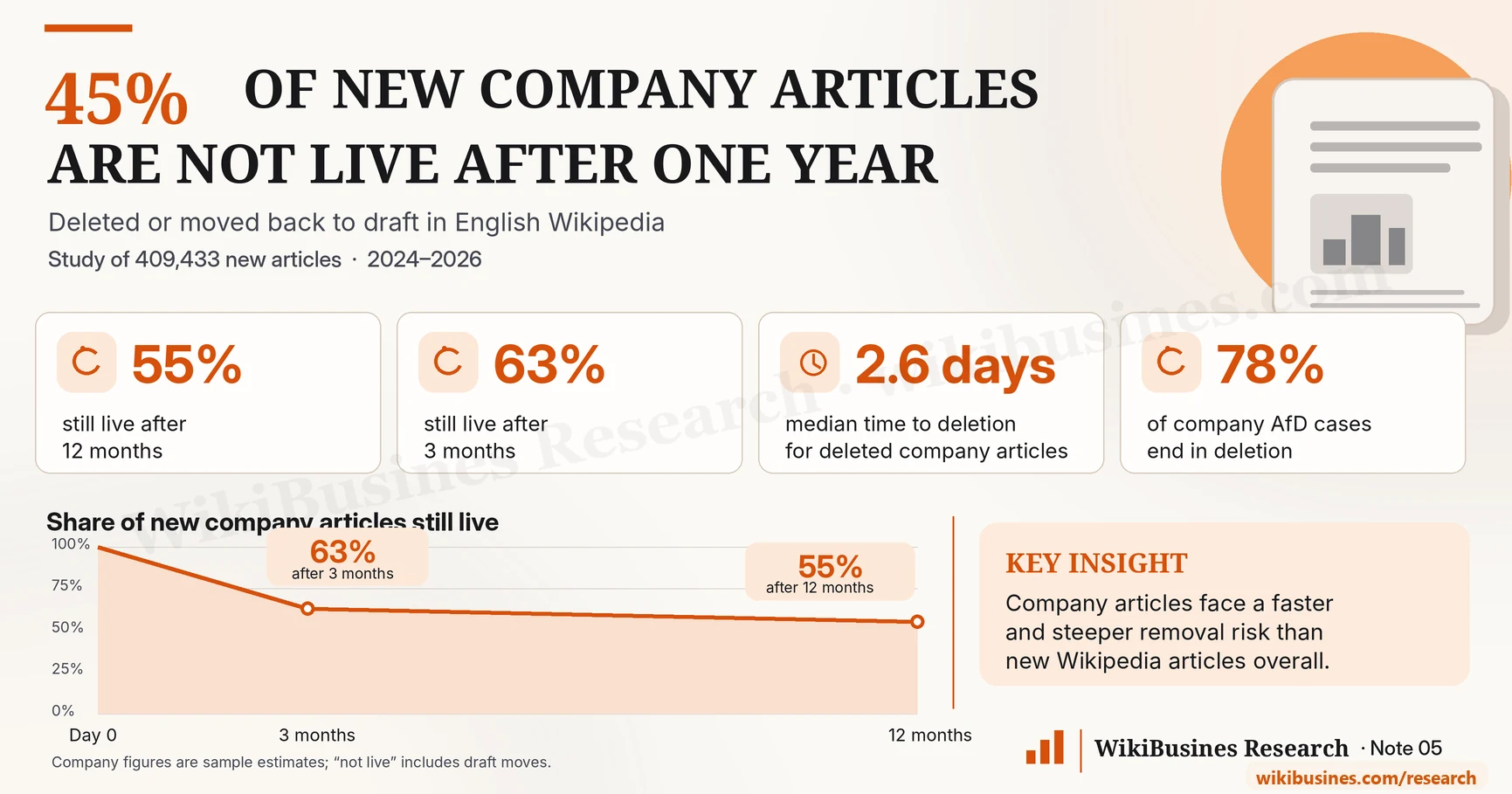
WIKIBUSINES RESEARCH
Research behind this page
Our own data on how Wikipedia treats company articles: deletions, sources, survival. Read the study, check the method, download the data.
All research →