
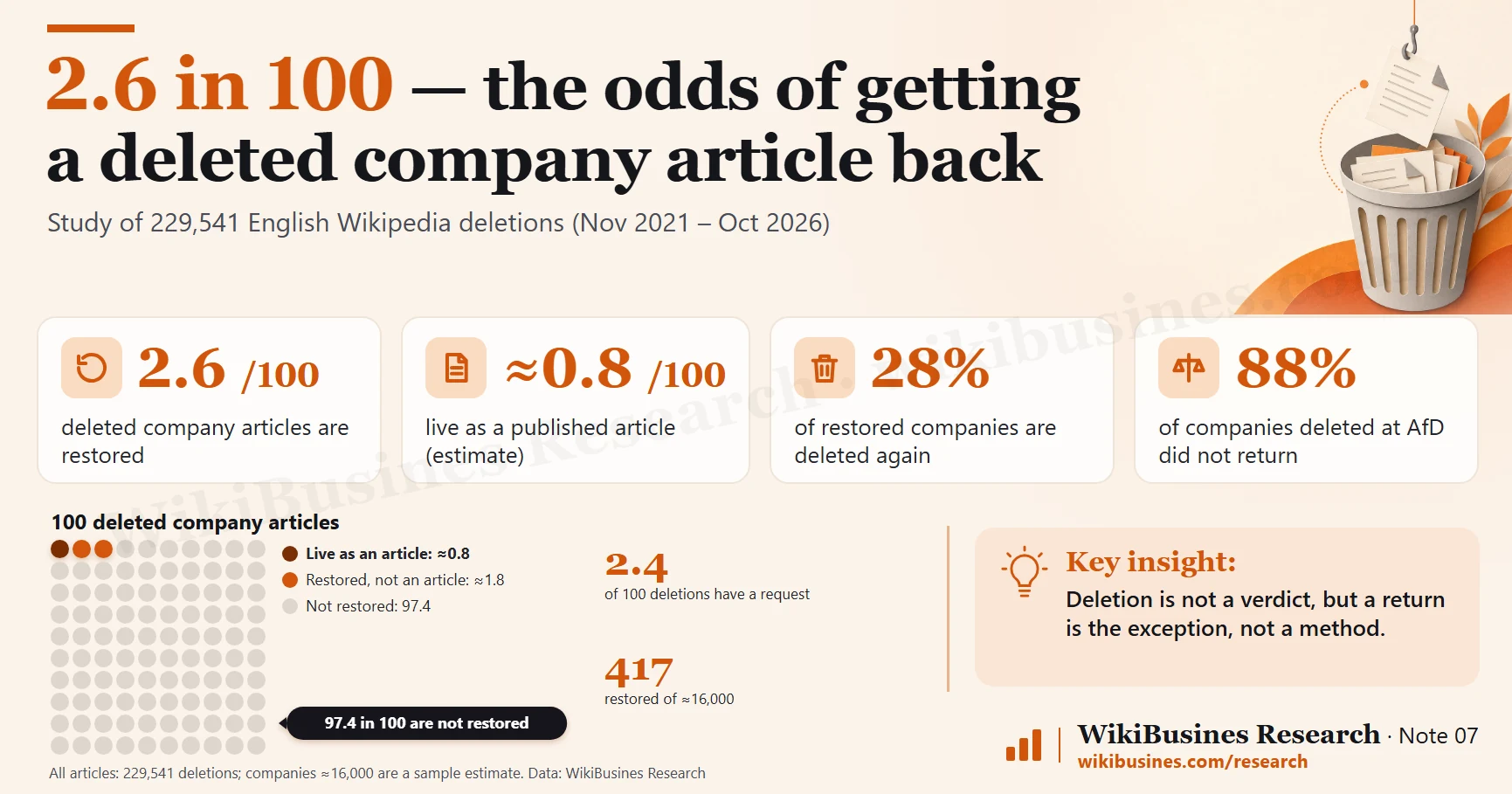
Of 100 deleted company articles, only 2.6 are restored and ≈0.8 live as an article
We traced 229,541 deletions of English Wikipedia articles from Nov 2021 to Oct 2026 (all articles). Company figures (≈16,000 deletions) are estimates from a stratified sample, as of the cut-off date.
Summary: what the study found
We analysed 229,541 deletions of English Wikipedia articles over five years and matched them with restoration, appeal and re-creation records, to find out whether a deleted article can realistically be brought back.
Key results
- 2.6 of 100 deleted company articles are later restored (confidence interval 2.3–3.0; 417 of ≈16,000)
- ≈0.8 of 100 still live as a full published article at the time of the check (estimate: 131 of ≈16,000)
- 28% of restored company articles are deleted again later (117 of 417)
- 1.6 of 100 articles of all kinds are restored by procedure after an ordinary AfD deletion; for companies the figure is 3.6%
- 88% of companies deleted at AfD did not come back, even counting re-creations (of 5,130)
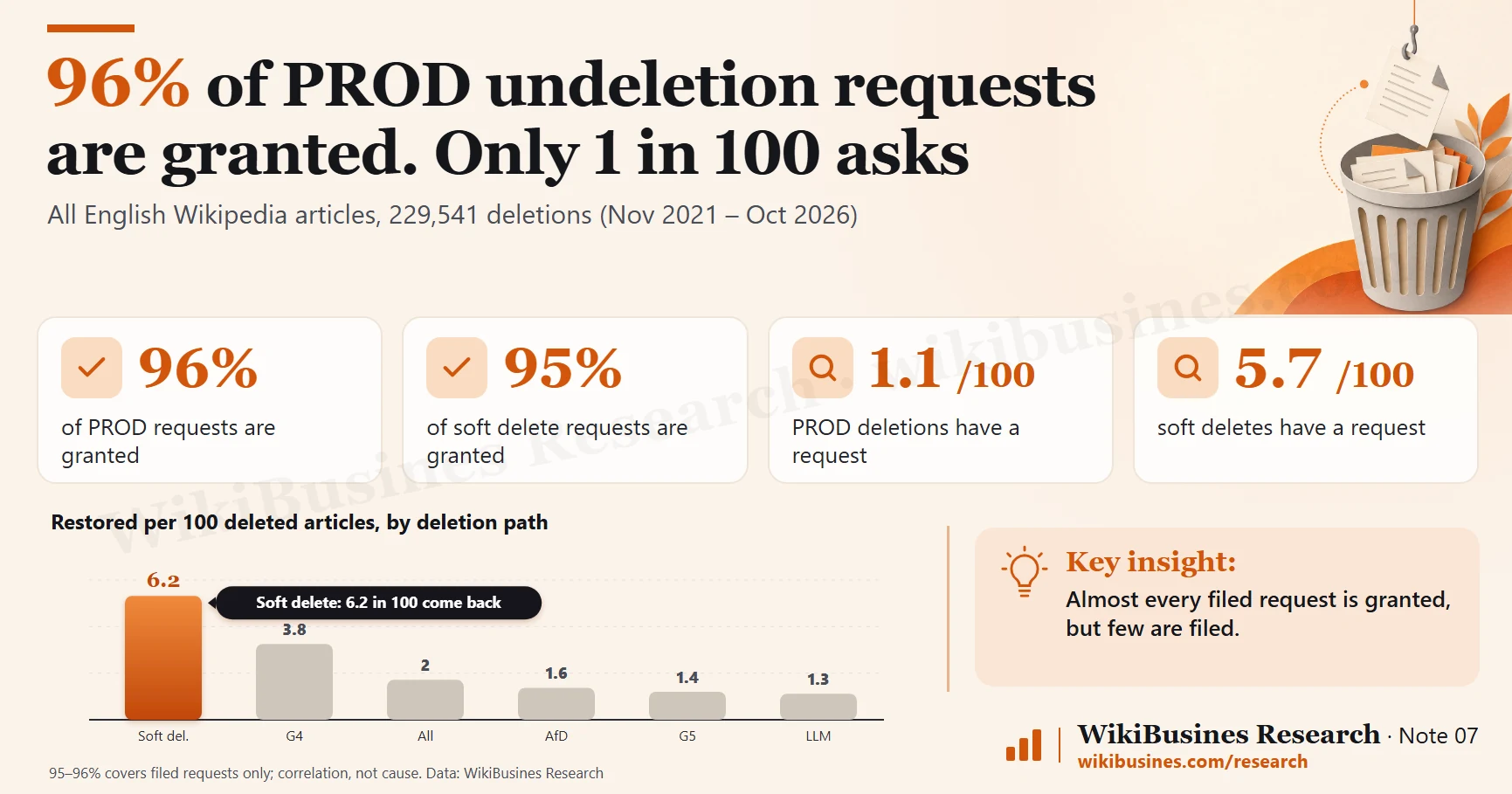
- 96% and 95% of filed requests after PROD and soft delete are granted (all articles), but they are filed for only 1.1 and 5.7 of 100 deletions
Before asking for restoration, find out the deletion path and whether the reason has been removed. An article returned without new independent sources soon lands in the same process: 28% of restored companies were deleted a second time.
2.6 and 0.8 are estimates for companies as of the cut-off date, not lifetime probabilities; the "company" segment is defined by title, ground and tags. The 96% and 95% shares cover filed requests only, and the link between deletion path and return is an observation, not a cause.
Key findings
- 1
Of 100 deleted company articles, 2.6 are restored and 0.8 live as an article.
estimate Of ≈16,000 company deletions, 417 were restored (CI 2.3–3.0). 72% went back as an article, 23% as a draft. 31% of the restored live as an article; 28% were deleted again.
- 2
All articles: 2.0 restorations per 100, 0.8 live; CEOs: 3.3–3.4, 0.9 live.
known Two numbers because there are two CEO definitions: AfD paths by tag (exact) and all paths by hand label (estimate).
- 3
Reversibility depends on the deletion path.
known Soft delete 6.2 per 100 (companies 10.0), G4 3.8, AfD 1.6, G5 1.4, LLM 1.3.
- 4
The rules allow restoration, but few people ask.
known Requests on PROD and soft delete are granted in 96% and 95% of cases, but they exist for only 1.1 and 5.7 of 100 deletions.
- 5
Restorations outnumber requests.
estimate For companies 44% of restorations (184 of 417) had no request we could find: mistaken deletions, reversed G5, contested PROD. The most common reason is REFUND (41%).
- 6
DRV: of 101 substantive decisions on companies and CEOs, the deletion was endorsed in 55%.
known 25% were returned as an article or a draft, 16% of AfDs relisted.
- 7
Without a procedure, pages almost never return.
known Of 5,130 companies deleted at AfD, 88% did not come back; 2.1% were re-created and live, 1.7% deleted under G4.
Can you get a deleted article back on Wikipedia? 229,541 deletions over five years (all articles; companies ≈16,000)
In plain words. Take 100 deleted company articles. For 2.4 of them someone filed a request: on REFUND (a request to undelete) or at Deletion review, DRV (an appeal of a closure). 2.6 were restored. Restorations outnumber requests because 44% of company restorations had no request we could find: an administrator restored the page when the deletion was mistaken (an author wrongly treated as a sockpuppet, a G5 deletion undone) or when the author contested a PROD (a proposed deletion that is reversed on request). Some of these cases may also be a failure to match by title.
Of the restored, 72% went back as an article, 23% as a draft. 0.8 of 100 deleted live as an article in the main space today. 0.6 of 100 went back only to a draft, and that is not a win: only 19% of such drafts become an article.
Funnel: request, restoration, a live article
Per 100 deleted articles. “Alive now” means the title is an article in the main space today. Hover a row for counts and the interval.
Companies and CEOs are sample estimates with an interval. CEOs are shown two ways because the definitions differ: the AfD tag “Businesspeople” is broader than the hand label “businessperson”. “All articles” and “CEOs, AfD paths” are counted exactly. A request = a REFUND or DRV found by title and date.
1,000 deleted company articles: who comes back
Each dot is one deleted article (of 1,000). Proportions come from the data; dots are rounded to whole units.
Which deletions are reversible
The deletion path decides whether it is reversed on request. PROD (proposed deletion without a discussion) and soft delete (an AfD closed as a soft deletion in the absence of objections) are, by the rules, restored on request, usually via REFUND. Speedy criteria (CSD: G4 re-creation, G5 author under a block, G11 promotion, A7 no indication of significance, G12 copyright, G7 author request, G15 and LLMPROD for LLM content) and ordinary AfD carry no such guarantee. The matrix covers five years: how many of 100 were restored, for how many a request was filed, how many requests were granted, how many live now.
Deletion path × reversibility
All articles, 5 years. Cell shade shows the relative value within a column. The highlighted column is how many of 100 deleted articles live now.
† — fewer than 20 company restorations, the number is indicative. The “companies” column is a sample estimate. “Request granted” = the share of filed requests that ended with a restoration. This is a correlation, not a cause.
Reversibility by deletion path
Each row is 100 deleted articles by path; the restored ones are highlighted, a solid fill marks those that live as an article now.
Why pages are restored
The reason was read from the restoration comment (classifier accuracy 88%, manual check of 50 cases). Of 4,555 restored articles: REFUND 41%, returned to a draft or user space 13%, no comment 8%, G5 reversed 7%, PROD contested 6.5%, soft delete 5.5%, mistaken deletion 5%, DRV 2.7%. For companies (5,130): REFUND 48%, draft or user space 16%, soft delete 10%, PROD 5.5%, DRV 1.9%.
REFUND over five years: 25,830 requests, 5,668 of them on articles (≈1,134 a year), 64% granted. About 589 concern companies (sample estimate). The median time from deletion to restoration is 8 days.
Restoration reasons by comment
Share of restored articles. One reason per restoration, so the bars sum to 100%.
The reason was read from the restoration comment (classifier, 88% accuracy on a manual check of 50 cases). “Other (small groups)” = author request, new notability, G13 draft restoration.
DRV: appealing a deletion
Deletion review asks whether a discussion was closed correctly or a speedy deletion was valid. Over five years there were 1,433 requests, 96 about companies and 40 about businesspeople. Of 136 decisions on companies and CEOs, 28 were closed procedurally (withdrawn, wrong venue) and 7 other; 101 were substantive. In those the deletion was endorsed in 55%, returned as an article or a draft in 25%, the AfD was relisted in 16%, no consensus 4%. For other people 31% were returned.
Of the 41 returns or relists the reasons are: draft without objection 10, speedy deletion without a criterion 9, closing error 7, split opinions at relist 5, administrator restored on their own 4, new sources 2, tainted discussion 2, other 2. The numbers are small, so we do not compare years.
Appeal outcomes and the reasons for returns
Substantive DRV decisions over 5 years (procedural closures — withdrawn, wrong venue, no basis — are not counted).
On the right, the reasons in 41 cases of return or relist (companies and CEOs). The numbers are small: intervals are wide and years are not compared. “Returned” = as an article, to a draft after DRV or to a draft without objection.
After restoration: a second deletion and the trend over the years
A restored article does not end the story. 28% of restored companies were deleted again, 90 of 117 of them under AfD. Among 237 companies returned as an article with a window of at least 12 months: 44% were not deleted again or moved to a draft, 33% were deleted again, 23% moved to a draft or user space. Today, of all restored: article 31%, redirect 5%, draft or user space 10%, moved to a draft and lost 21%, deleted and gone 32%.
The second deletion
100 restored company articles: where they went back, what happened within 12 months and where they are today.
Trend: restored within 12 months, Y1–Y4
Is it changing. Companies restored within 12 months per 100 deleted: Y1 2.6, Y2 2.8, Y3 1.6, Y4 2.7; the intervals overlap. A year is November–October; Y5 is not shown because its window is under 12 months. G13 drafts are deleted in growing numbers (70,589 in Y1, 73,249 in Y5) and restored less often (5.7 and 3.2 per 100; incomplete window in Y5).
The dot is the estimate, the segment the 95% interval (for “all articles” the interval is narrow and not shown). Y1 = Nov 2021 – Oct 2022 … Y4 = Nov 2024 – Oct 2025; Y5 is not shown because its window is under 12 months.
Without a procedure: re-creation
An article can be created again instead of restored. Of 5,130 companies deleted at AfD: restored by procedure 3.6%; did not return 88.3%; re-created and live 2.1%; now a redirect 1.9%; re-created and deleted under G4 1.7%; went through AfD again 1.3%; deleted on another ground 1.2%. The content reappears in about 6% of cases (excluding redirects). For CEO articles (2,912): did not return 85.0%, live 2.8%, G4 3.2%.
What happened to those deleted at AfD
Companies and CEOs deleted at AfD over 5 years. The top bar is 100%; the bottom bar covers only those that came back, with 100% = came back.
AfD deletions by deletion-sorting tags (exact). “Now a redirect” is a separate category; “re-created” excludes redirects. Titles were compared after normalisation.
Interpretation
WikiBusines Research data show that after a company article is deleted on English Wikipedia, 2.6 of 100 are restored and 0.8 live as an article, so restoration is not a reliable route. Main hypothesis hypothesis: what comes back is what the rules reverse on request (PROD, soft delete) and mistaken deletions; ordinary community decisions (AfD) are almost never reversed, and what limits returns is not the decision but that requests are rarely filed. Most likely scenario for the next 6–12 months hypothesis: the rate stays between 2.1 and 2.7 restorations per 100 for companies, with about 0.8 living as an article; a larger share of speedy LLM deletions (restoration 1.3 per 100) may lower the overall rate slightly.
Why do soft delete and PROD come back more often? A hypothesis; the data do not prove it. The rules expressly allow restoration on request, and a closure without discussion means nobody settled the notability question on the merits.
Does restoration mean a win? No. 69% of restored companies are not an article today, and of those restored to a draft, 19% become an article.
Why do restorations outnumber requests? Hypothesis: part are initiated by administrators (mistaken deletion, reversed G5, contested PROD), and part of the requests were not found by title. The data do not distinguish these cases.
What do the data not show? The quality of individual articles and why an author did not file a request. The link between deletion path and reversibility is an observation, not a cause. We did not read article texts: the "company" segment is defined by title, ground and tags.
Summary, hypotheses and forecast
What we know
- Of 229,541 deletions, 4,548 were restored (2.0 per 100); 0.8 per 100 live as an article. known
- Companies: 2.6 restored per 100 (CI 2.3–3.0), ≈0.8 live as an article. estimate
- Soft delete 6.2 per 100 (companies 10.0), AfD 1.6, G5 1.4. known
- Requests on PROD and soft delete are granted in 96% and 95%, but filed for 1.1 and 5.7 of 100. known
- DRV: endorsed 55%, returned 25%, relisted 16% (101 decisions on companies and CEOs). known
Hypotheses and what would test them
- H1. Returns are limited by the filing of requests, not by decisions. hypothesis Confirmed if: in the next update (June 2027) requests on soft delete stay near 5.7 per 100 and the grant rate stays above 90%. Refuted if: requests rise markedly while the grant rate falls.
- H2. Restorations without a request are mostly initiated by administrators correcting mistakes. hypothesis Confirmed if: in a new cut the comments of such restorations are mainly about a mistake, G5 or PROD. Refuted if: requests that did not reach REFUND dominate.
- H3. Articles deleted for content (G12, LLM) live more often after restoration than those deleted for notability (A7, other speedy). hypothesis Confirmed if: the gap (60% against 30% and 24%) holds with more data. Refuted if: the LLM value (little data) falls to the A7 level.
How we read it
In plain words. PROD and soft delete are reversed if you ask. But few ask, and what is returned does not live long: fewer than one in 100 deleted company articles remains an article.
What to do about it. Before asking for restoration, find out the deletion path and whether the reason was removed. A restored article without new independent sources soon returns to the same process.
Forecast and model
Company restorations in a year = N × r, where N = mean company deletions in Y3–Y5 (≈3,260 a year) and r = share restored within 12 months. Live articles: N × r × s, where s = share of the restored that is an article today. Baseline: r = 2.38 per 100, s = 31%, ≈78 restorations and ≈24 live articles. Milder (upper CI bounds: r = 2.74, s = 36%): ≈89 and ≈32. Harsher (lower bounds: r = 2.07, s = 27%): ≈67 and ≈18. Assumptions: volume and rate as in Y3–Y5, restorations even across the year, s from the current state; the CI bounds are not independent, so the range is wider than the real one.
The model illustrates assumptions; it is not a prediction.
What to do
For CEOs and marketing: find out how it was deleted
An article deleted under PROD or soft delete is restored on request in 95%–96% of cases, if a request is filed. A deletion at AfD or under a speedy criterion does not work that way: restoration by procedure remains an exception (3.6% for companies after AfD). A return to a draft is not the end: 19% of such drafts move into the main space.
For PR and SEO agencies: do not promise "restoration"
The base rate for companies is 2.6 of 100, with 0.8 living as an article. An honest offer is an analysis of the deletion path, a check of independent sources and, if there are grounds, a transparent request that discloses the connection.
How to file a request legitimately
- Find the ground and path in the deletion log: PROD, soft delete, speedy (CSD) or AfD.
- If it is PROD or soft delete and the reason has been removed, file REFUND: briefly describe what changed and add independent sources.
- Disclose your connection to the company and any payment (WP:COI) on your user page and in the request. Do not use additional accounts and do not ask others to write in support.
- If the page was deleted at AfD, DRV is appropriate only for a procedural error or significant new sources; otherwise write a new draft via Articles for creation.
- Do not treat a return to a draft as a win: the draft must be brought up to the sources before review.
- Schedule a review in 12 months: among companies restored as an article, 44% were not deleted again or moved to a draft.
Six questions before a restoration request.
Methodology and limitations
Period 1 Nov 2021 – 31 Oct 2026, English Wikipedia; public APIs (MediaWiki, Wikidata), no login and no edits, as of 13 Nov 2026. Editor names were not requested; article titles stay in private files. A year is November–October (Y1–Y5); Y5 has less than 12 months of observation, so the "within 12 months" series cover Y1–Y4.
The unit is a non-technical deletion of a main-space article (no G8/R2/R3 redirects, history merges or RfD). AfD discussions are collapsed into one deletion: 229,541 units from 462,932 log events. "Restored" is the first non-technical restoration of the same title after deletion (in the main space, Draft: or user space); restoration into a redirect is not counted. REFUND (25,830) and DRV (1,433) requests were matched to deletions by normalised title and date.
The segment for AfD paths comes from deletion-sorting tags, for the rest from a hand label by title and ground (agents with a code book; ≈95% on a manual check). AfD tags miss about 15% of companies. The hand-labelled "businessperson" is narrower than the "Businesspeople" tag, so two views are given for CEOs. The denominator outside AfD is estimated from a stratified sample (path × year) with Jeffreys intervals: they are wide in small cells.
Accuracy: restoration reasons 88% (50 cases); title matching ≈95% on REFUND requests marked "done"; AfD table join 99.4%. After the double count of relisted AfDs was fixed in R2, the join was checked: R7 links AfD by discussion page name (106,158 unique discussions), and the result is identical on raw and deduplicated files. During labelling, one agent was wrongly given a hint of "15–20% companies"; in its batch the result was 9%, so the result was not forced to the hint, but we do not rule out an effect on borderline titles: the segment in that batch carries extra uncertainty.
Limitations. Title matching does not see renames before deletion. "Live at 12 months" is a proxy from deletion and move logs, not the state on day +12 months. We did not read article texts. For G4, G7, G12, LLM, G5 and other CSD there are fewer than 20 company restorations: the numbers are indicative (marked on the matrix). These are correlations, not causes.
Sources
English Wikipedia policies and pages that the note relies on; the data sources are the deletion, restoration, REFUND and DRV logs.
- WP:REFUNDen.wikipedia.org/wiki/Wikipedia:Requests_for_undeletion
- WP:DRVen.wikipedia.org/wiki/Wikipedia:Deletion_review
- WP:PRODen.wikipedia.org/wiki/Wikipedia:Proposed_deletion
- WP:SOFTDELETEen.wikipedia.org/wiki/Wikipedia:Deletion_policy#Soft_deletion
- WP:G4en.wikipedia.org/wiki/Wikipedia:Criteria_for_speedy_deletion#G4
- WP:CSDen.wikipedia.org/wiki/Wikipedia:Criteria_for_speedy_deletion
- WP:AFDen.wikipedia.org/wiki/Wikipedia:Articles_for_deletion
- WP:COIen.wikipedia.org/wiki/Wikipedia:Conflict_of_interest
- Articles for creationen.wikipedia.org/wiki/Wikipedia:Articles_for_creation
- Deletion logen.wikipedia.org/wiki/Special:Log/delete
License
Data and text are available under CC BY 4.0 with attribution to "WikiBusines Research". Wikipedia discussion texts are licensed CC BY-SA 4.0; we do not republish them.
Downloads are aggregates only (path, year, segment): no page titles and no editor names.
WHAT TO DO ABOUT IT
Check your company before you publish, not after the deletion
An article's fate is settled before it goes live: either the independent sources exist or they don't. We assess your company's notability against Wikipedia's rules and tell you honestly whether an article makes sense now.
- Quick assessment, about 10 minutes — free
- If in doubt, a notability audit from €490, credited toward the page
- We publish with paid-editing disclosure, as Wikipedia's terms require